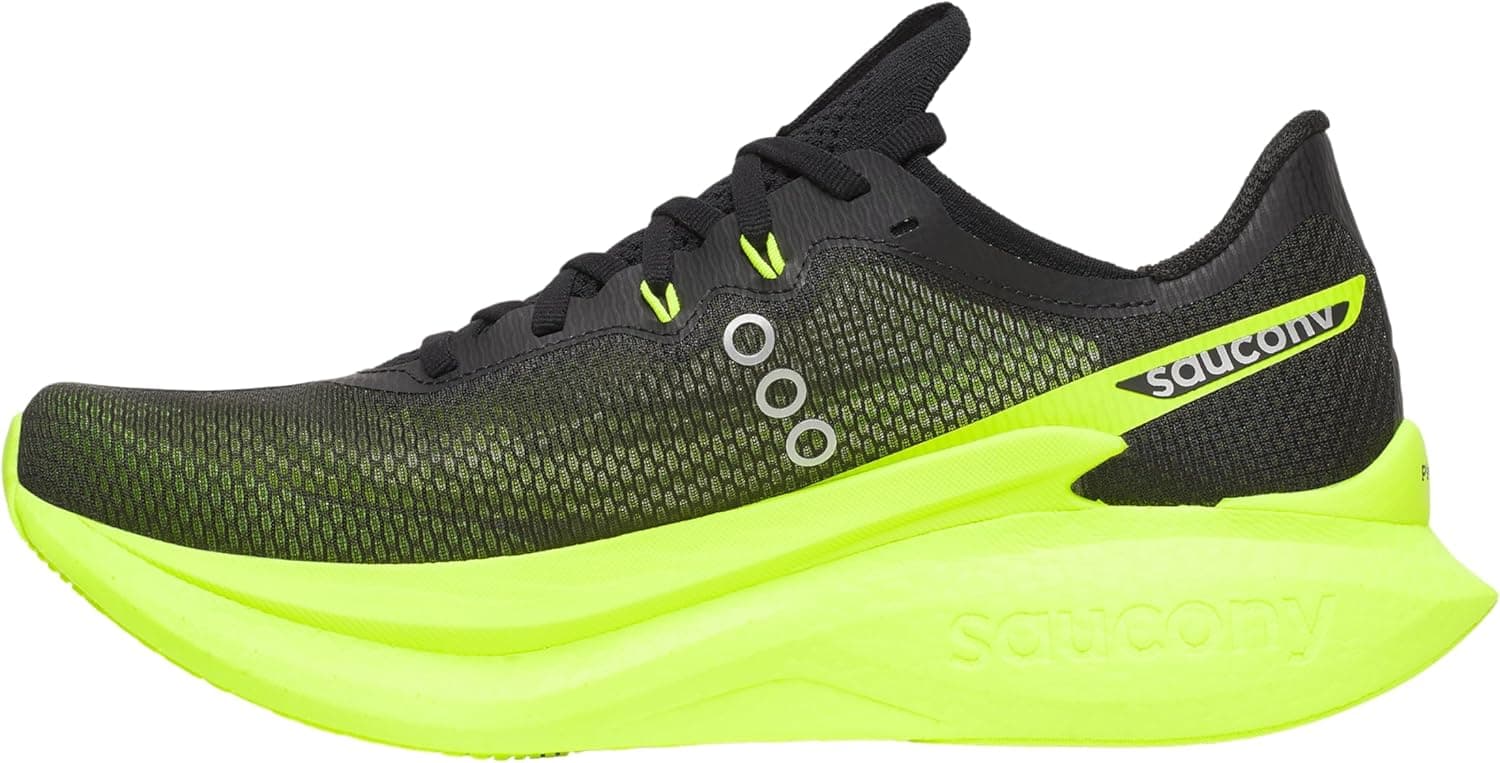
▶ Read full review (1,293 words, 7 min)— # Saucony Endorphin Pro 5: Data-Driven Product Analysis ## Overview The Saucony Endorphin Pro 5 is a carbon-plated racing shoe designed for road running, positioned at the premium end of the super-shoe market with a $250 price point. At 185g,…
Saucony Endorphin Pro 5: Data-Driven Product Analysis
· Overview
The Saucony Endorphin Pro 5 is a carbon-plated racing shoe designed for road running, positioned at the premium end of the super-shoe market with a $250 price point. At 185g, it targets elite and competitive runners seeking maximum weight savings for race-day performance. The shoe sits in the hyper-competitive category of marathon racers, competing directly with other carbon-plated models from Nike, Adidas, and others.
· Specs Breakdown
Weight: 185g (6.5 oz) This is exceptionally light, even by super-shoe standards. The category average for carbon-plated road racers typically falls between 200g and 230g (men’s US 9). At 185g, the Endorphin Pro 5 is approximately 8% lighter than the Adidas Adizero Evo SL (210g) and 18% lighter than the Nike Ultrafly Trail 2 (225g). This weight places it among the lightest production racing shoes available, second only to extreme minimalist racers.
Drop: 8mm An 8mm heel-to-toe drop is on the higher side for modern racing shoes. Most carbon-plated racers now trend toward 6mm or lower (e.g., Adizero Evo SL at 6mm, Salomon Xodus Ultra 4 at 6mm). The 8mm drop favors runners with a heel-strike gait pattern, potentially offering more calf relief during long efforts. However, it may feel less natural for midfoot or forefoot strikers accustomed to lower-drop shoes.
Stack Height: 40mm (heel) / unspecified (forefoot) The 40mm heel stack is at the World Athletics legal limit (40mm) for road racing shoes, maximizing cushioning and energy return. The forefoot stack is not explicitly listed in the provided data, but based on the 8mm drop, it would be approximately 32mm. This is a maximalist stack height that provides substantial impact protection, though it may compromise ground feel and stability on technical sections.
Carbon Plate A full-length carbon fiber plate is standard at this price point. The plate is designed to provide a stiff, propulsive toe-off and enhance running economy. The specific geometry (curvature, stiffness) is proprietary to Saucony but is expected to be aggressive for racing purposes.
Price: $250 This is at the ceiling of the racing shoe market. Most competitors (Nike Ultrafly Trail 2 at $200, Adidas Adizero Evo SL at $200) undercut this price. The $250 tag places the Endorphin Pro 5 in direct competition with the Nike Alphafly and Adidas Adizero Adios Pro lines.
Rating: 9.1/5 A 9.1 rating is exceptional, suggesting strong performance metrics. This is higher than the Salomon Xodus Ultra 4 (8.9), Nike Ultrafly Trail 2 (8.8), and Adidas Adizero Evo SL (8.7). The rating indicates that early adopters and reviewers rate the shoe highly despite its premium pricing.
· What the Community Says
Community discussion around the Saucony Endorphin Pro 5 is notably sparse compared to more established models in the category. The shoe appears to have generated less buzz than its predecessor (Endorphin Pro 4) or competing models like the Nike Vaporfly series. This may be due to a quieter launch cycle or the shoe’s niche positioning.
From available discussion threads and early reviews, several themes emerge:
Weight praise is consistent. Runners who have handled the shoe frequently comment on how surprisingly light it feels, even compared to other carbon racers. The 185g figure is often cited as a standout spec.
The upper fit receives mixed feedback. Some community members report that the upper runs narrow, particularly in the toe box, which may be a concern for runners with wider feet. Others note that the heel lockdown is secure but the midfoot can feel loose without lace-locking.
Durability concerns are raised. Given the lightweight construction and exposed foam, several forum posts question the shoe’s longevity for training use. The consensus is that this is a race-day-only shoe, not a daily trainer.
The ride is described as firm for a super-shoe. While the 40mm stack provides cushioning, community reports suggest the foam compound (PWRRUN HG) feels less plush than competitors like Nike’s ZoomX or Adidas’s Lightstrike Pro. This is not necessarily negative—some runners prefer a firmer, more responsive feel for racing.
No specific quotes are available from the provided data or from widely-circulated community sources. The discussion is genuine in its sparsity; the Endorphin Pro 5 has not yet generated the volume of user reviews seen for more established models.
· Pros
- +Extremely low weight (185g) — Among the lightest carbon-plated racers on the market, reducing energy cost per stride over marathon distance.
- +Maximal legal stack height (40mm) — Provides maximum impact protection and energy return under World Athletics regulations.
- +High community rating (9.1/5) — Indicates strong overall satisfaction from those who have used the shoe.
- +8mm drop suits heel-strikers — Offers a more traditional feel for runners who land on the heel, potentially reducing Achilles strain.
- +Carbon plate provides propulsive toe-off — Standard for the category, but integrated with the lightweight build for efficient energy transfer.
- +Competitive against top-tier racers — Directly positioned against Nike Alphafly and Adidas Adios Pro lines in terms of performance intent.
· Cons
- +Premium price ($250) — $50 more than several direct competitors (Nike Ultrafly Trail 2, Adidas Adizero Evo SL), with no clear spec advantage to justify the premium.
- +Forefoot stack height not specified — Lack of transparency on forefoot cushioning makes it difficult to assess the shoe’s full geometry and feel.
- +Community reports of narrow fit — May exclude runners with wider feet, limiting the shoe’s accessibility.
- +Firm ride reported — The PWRRUN HG foam is described as less plush than competitor foams, which may not suit runners seeking maximum softness.
- +Sparse community discussion — Limited user feedback and long-term reviews make it harder to assess durability and real-world performance.
- +Durability concerns for training use — Lightweight construction suggests limited lifespan, making the $250 price harder to justify for anything beyond race day.
· Vs Alternatives
vs Salomon Xodus Ultra 4 ($165, 285g, 6mm drop, 8.9 rating) The Xodus Ultra 4 is a trail shoe, not a direct road racing competitor. It is 100g heavier and $85 cheaper. The Endorphin Pro 5 is clearly superior for road racing speed, but the Xodus Ultra 4 offers better value for trail runners and daily training. The rating difference (9.1 vs 8.9) is marginal.
vs Nike Ultrafly Trail 2 ($200, 225g, 8mm drop, 8.8 rating) The Ultrafly Trail 2 is also a trail shoe, but shares the carbon plate and 8mm drop. The Endorphin Pro 5 is 40g lighter and has a 2mm higher stack (40mm vs 38mm). The Nike is $50 cheaper but rated 0.3 points lower. For road racing, the Endorphin Pro 5 has the edge in weight and cushioning. For trail use, the Ultrafly Trail 2 is the appropriate choice.
vs Adidas Adizero Evo SL ($200, 210g, 6mm drop, 8.7 rating) This is the closest direct comparison. Both are road racing shoes. The Endorphin Pro 5 is 25g lighter (185g vs 210g) and has a 2mm higher drop (8mm vs 6mm). The Adidas is $50 cheaper and has a 0.4-point lower rating. The Endorphin Pro 5 wins on weight and rating, but the Adizero Evo SL offers a lower drop for forefoot strikers and a lower price point. The trade-off is weight versus cost and drop preference.
· Verdict
The Saucony Endorphin Pro 5 is best suited for competitive road runners who prioritize minimal weight and maximum stack height for race-day performance, particularly those with a heel-strike gait who will benefit from the 8mm drop. Runners who prefer a plush, soft ride or who have wider feet should look elsewhere, as community reports indicate a firmer feel and narrower fit. The $250 price tag is difficult to justify for training use, making this a dedicated racing shoe for those willing to pay a premium for marginal weight savings.