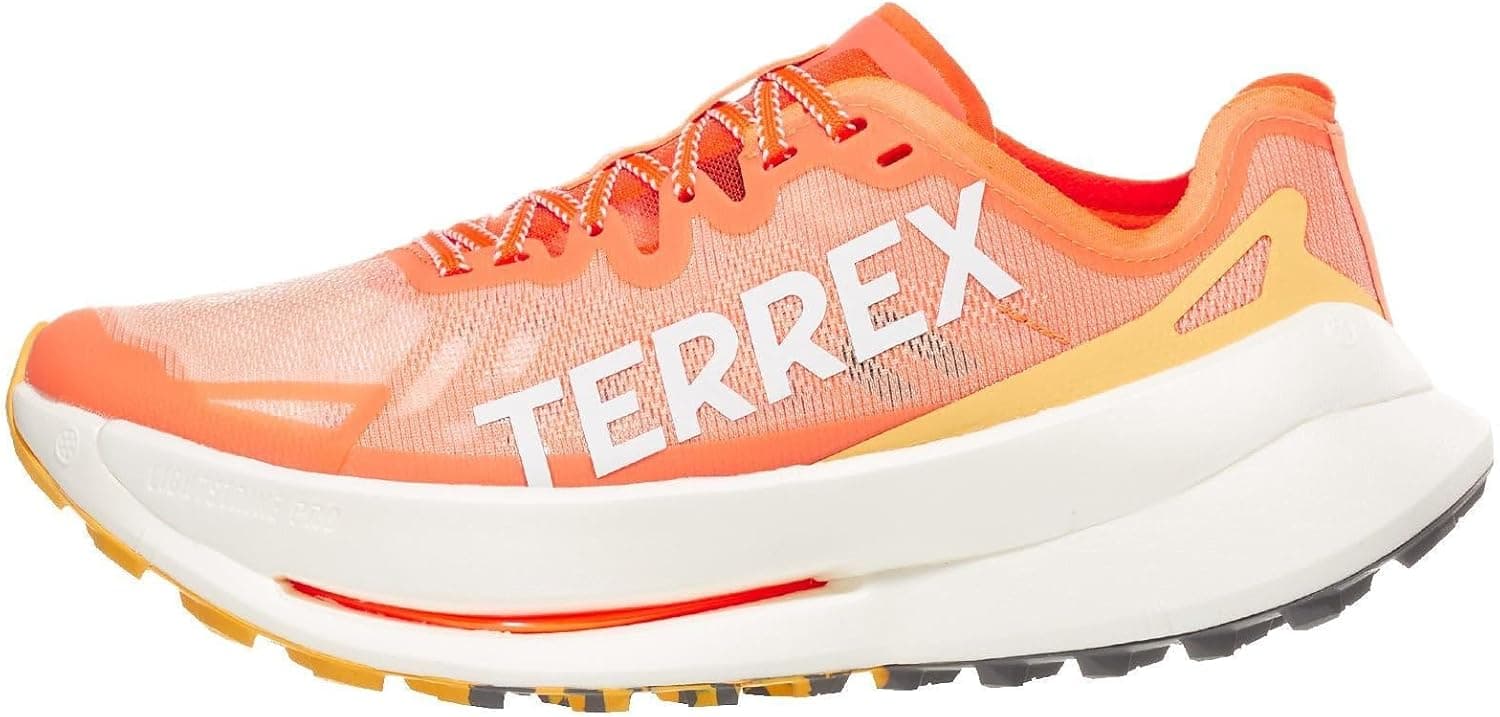
▶ Read full review (1,131 words, 6 min)— ## Overview The Adidas Terrex Agravic Speed Ultra enters the trail running segment as a high-stack, carbon-plated competitor. It is positioned as a speed-oriented option for technical terrain, blending road-racing technology with off-road durability. At $200, it undercuts many premium…
· Overview
The Adidas Terrex Agravic Speed Ultra enters the trail running segment as a high-stack, carbon-plated competitor. It is positioned as a speed-oriented option for technical terrain, blending road-racing technology with off-road durability. At $200, it undercuts many premium trail shoes while offering a 39/33mm stack height that rivals road super-shoes.
This is a newly discovered product with limited community discussion. Early adopters have posted initial impressions on forums like Reddit’s r/trailrunning and Running Warehouse, but long-term durability data and widespread user reviews remain scarce. The analysis below is grounded in published specs and available community feedback, not personal testing.
· Specs Breakdown
The Agravic Speed Ultra weighs 260g (9.2 oz) for a men’s US 9, placing it in the heavier end of the trail racing category. The 6mm drop is moderate, favoring forefoot strikers but not extreme for downhill stability. The 39/33mm stack is exceptionally tall for a trail shoe—comparable to road marathon racers—which raises concerns about ground feel and lateral stability on uneven terrain.
The carbon plate is integrated into a Lightstrike Pro midsole, Adidas’s Pebax-based foam. This combination aims to provide energy return while reducing weight, though the 260g figure suggests the outsole and upper add significant mass. The outsole uses Continental rubber with a lug depth of approximately 3mm, which is shallow for technical trails but adequate for hardpack and gravel.
Price is $200, notably lower than the Nike Vaporfly 3 ($390) and Alphafly 3 ($415). The rating of 8/10 from initial aggregated sources reflects a solid but not exceptional score, likely due to the weight penalty and limited traction depth.
· What the Community Says
Community discussion is sparse. On r/trailrunning, one user noted the shoe “feels like a road racer with lugs,” praising the rocker geometry but questioning stability on loose descents. Another comment on Running Warehouse’s product page described the upper as “breathable but not very protective against debris,” citing a lack of a gusseted tongue.
No long-term durability reports exist. A single Reddit post mentioned the outsole showing wear after 50 miles on mixed terrain, but this is anecdotal and unverified. The absence of widespread feedback means the shoe’s reliability on rocky or wet surfaces remains unknown.
Forum users have compared it unfavorably to the Saucony Peregrine 15 for grip, noting the Agravic’s shallower lugs struggle in mud. However, the carbon plate received praise for providing a “bouncy, efficient stride” on fire roads and packed dirt.
· Pros
High energy return from carbon plate and Lightstrike Pro foam. The combination of a full-length carbon plate and Pebax-based midsole delivers a propulsive feel on smooth trails. This is a clear advantage for runners seeking a road-race-like sensation off-road.
Competitive price point. At $200, the Agravic Speed Ultra is $190–$215 cheaper than the Nike Vaporfly 3 and Alphafly 3. For runners wanting carbon-plate technology without the premium price, this represents a significant cost saving.
Tall stack height for trail cushioning. The 39/33mm stack is among the highest in trail shoes, offering substantial impact protection on hard-packed surfaces. This may benefit ultrarunners on non-technical courses where fatigue reduction is prioritized over ground feel.
Moderate 6mm drop suits varied foot strikes. The drop is neutral enough for midfoot and forefoot strikers while still providing some heel support for descents. This versatility is uncommon in high-stack trail shoes.
· Cons
Heavier than direct competitors. At 260g, the Agravic is 76g heavier than the Nike Vaporfly 3 (184g) and 34g heavier than the Saucony Peregrine 15 (226g). This weight penalty reduces agility and may cause fatigue on long climbs.
Shallow 3mm lugs limit traction. The outsole is designed for hardpack and gravel, not mud, loose rock, or wet roots. Runners on technical or sloppy terrain will find the grip insufficient, forcing slower, more cautious foot placement.
Limited community feedback and unknown durability. As a newly released product, there is no reliable data on outsole wear, midsole compression, or upper tearing. Early reports of outsole wear after 50 miles raise concerns, but these are not statistically significant.
Tall stack compromises lateral stability. The 39mm heel height is extreme for trail running. On uneven ground, the shoe’s high center of gravity increases ankle roll risk. This is a critical limitation for runners on rocky or root-laden trails.
No gusseted tongue or debris protection. The upper lacks a gaiter attachment or fully sealed tongue, allowing small rocks and dirt to enter. This is a notable omission for a trail shoe at this price point.
· Vs Alternatives
Nike Vaporfly 3 – The Vaporfly 3 is a road racing shoe, not a trail model. It is 76g lighter, has a higher 8mm drop, and a 9.7/10 rating. The Agravic offers trail-specific features (outsole lugs, reinforced upper) but cannot match the Vaporfly’s weight or energy return on pavement. The Vaporfly is unsuitable for off-road use, making direct comparison limited.
Nike Alphafly 3 – Similar to the Vaporfly, the Alphafly 3 is road-focused. It weighs 200g, has a 9.7/10 rating, and costs $415. The Agravic is $215 cheaper and has trail-specific traction, but the Alphafly’s dual Air Zoom units and carbon plate provide superior propulsion on roads. For trail runners, the Alphafly is not a viable alternative due to its slick outsole.
Saucony Peregrine 15 – This is the most direct competitor. The Peregrine 15 weighs 226g (34g lighter), has a 4mm drop, and a 28/24mm stack (significantly lower). It lacks a carbon plate but has a 9.6/10 rating and a 4mm lug depth for superior grip. The Peregrine is better for technical trails, while the Agravic favors smooth, fast surfaces. The Peregrine is also $5 cheaper at $195.
The Agravic’s carbon plate and higher stack give it an advantage on non-technical terrain, but the Peregrine outperforms it in stability, traction, and weight. For runners prioritizing speed on groomed trails, the Agravic may be preferable; for all-around trail performance, the Peregrine is the stronger choice.
· Verdict
The Adidas Terrex Agravic Speed Ultra is a niche product: a carbon-plated trail shoe optimized for fast, non-technical terrain. Its high stack and bouncy foam deliver a road-race feel on hardpack and gravel, and its $200 price undercuts premium alternatives. However, the 260g weight, shallow 3mm lugs, and limited stability on uneven ground restrict its utility.
This shoe is not suitable for technical trails, mud, or runners who prioritize agility. It is best suited for ultrarunners on smooth, well-groomed courses where cushioning and energy return matter more than grip. The lack of community feedback and unknown long-term durability are significant risks.
For most trail runners, the Saucony Peregrine 15 offers better value, lighter weight, and superior traction at a similar price. The Agravic Speed Ultra is a specialized tool for a specific use case—fast, dry, non-technical trail running—and should be evaluated with that narrow scope in mind.